Introducing the 2026 integrated report
We have pleasure in presenting the Clicks Group integrated report for the 2026 financial year. Improving macroeconomic conditions in South Africa during the first half of the financial year supported a gradual recovery in consumer spending. However, the outbreak of hostilities in the Middle East in late February 2026 heightened global economic uncertainty and triggered a sharp increase in international energy prices. The resulting surge in domestic fuel prices created significant inflationary pressure which placed renewed strain on consumers and slowed the pace of South Africa’s economic recovery.
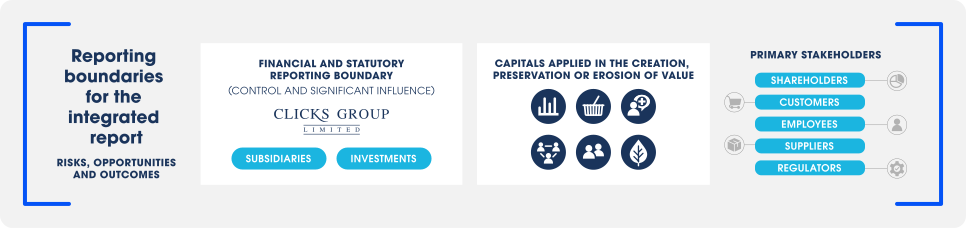
This report is aimed mainly at our shareholders, being our primary providers of capital, and the broader investment community. We also recognise the role and contribution of our customers, staff, suppliers, regulators and funding institutions in the creation, preservation and protection of value erosion.
Reporting scope and boundary
The report covers material information relating to the group’s business model, strategy, material issues, risks and opportunities, and performance for the financial year 1 September 2025 to 31 August 2026.
Forward-looking information mainly focuses on the strategic objectives, operating plans and prospects for the 2027 financial year, together with the medium-term financial targets.
The financial reporting boundary covers the performance of the group’s main operating businesses, Clicks and UPD, and focuses on the operations in South Africa where the majority of group revenue is generated. The group also operates 68 stores in four neighbouring countries.
The integrated reporting boundary extends beyond the financial reporting boundary to include the material risks, opportunities and outcomes arising from the group’s operating environment, businesses and strategy. The boundary also incorporates engagement with key stakeholders that could influence the group’s ability to create and sustain value.
Reporting and governance compliance
The group has applied the Integrated Reporting Framework of the International Financial Reporting Standards (IFRS) Foundation and JSE Sustainability Disclosure Guidance in preparing this report. The application of these reporting frameworks was proposed by management and approved by the board.
The Integrated Reporting Framework recommends reporting to shareholders on the capital resources that are applied in the creation, preservation or erosion of value. The impact of the six capitals on the group’s business activities and performance is covered in the relevant sections of the report.
All reporting complies with IFRS Accounting Standards, the South African Companies Act and its amendments, and the JSE Listings Requirements.
The King V Report on Corporate Governance for South Africa (King V) was released in October 2025 and is effective for companies with financial years beginning on or after 1 January 2026. During the 2026 financial year the group applied the principles of King IV and following the publication of King V, commenced the transition to the new code. The directors confirm that the group has in all material respects voluntarily applied the principles and recommended practices of the code, except for the specific exceptions noted in the King V Disclosure Framework which is available on the group’s website. The board plans to complete the transition to King V in the 2027 financial year.
The group is preparing for the phased adoption of the International Sustainability Standards Board’s IFRS S1 and S2 sustainability reporting standards. While these standards are not yet mandatory in South Africa, the group will progressively align its sustainability-related financial disclosures with their requirements.
Materiality
The group applies the concept of double materiality to its integrated reporting, covering both financial and impact materiality.
Financial materiality is applied in reports and disclosures that are targeted primarily at shareholders and other providers of capital used in determining enterprise value. The group’s financial materiality assessment considers internal and external factors, both positive and negative, that could substantively affect its ability to execute its strategy and which could have a material impact of 5% or more on the group’s profit before taxation.
Impact materiality considers the social, environmental and economic impacts of our operations and we aim to enhance the measurement and disclosure of impact reporting each year.
The integrated report applies double materiality as it covers content and disclosures that are material to investors and other providers of capital (financial materiality) as well as the impacts on people, the planet and profits (impact materiality). This approach is consistent with the JSE Sustainability Disclosure Guidance’s distinction between financial materiality, impact materiality and double materiality.
Independent assurance
The integrated report has been reviewed by the board but has not been independently assured. The annual financial statements have been independently audited by KPMG Inc.
Sustainability information included in the report has been approved by the board’s social and ethics committee. Accredited service providers have measured selected non-financial performance metrics and management has verified the processes for measuring all other non-financial information.
Integrated reporting process
The preparation of the integrated report is the responsibility of a working group led by the chief executive officer (CEO) and chief financial officer (CFO), comprising senior members from finance, marketing and human resources, the company secretary and the group’s external investor relations consultants.
The integrated report working group aims to enhance the reporting and disclosure each year. Draft reports are initially reviewed by the CFO and the CEO, with specific reports being reviewed and approved by the board chairman and the respective board committee chairs.
The completed integrated report is reviewed by all directors prior to being recommended for approval. The chairman of the audit and risk committee is responsible for the final approval of the report on behalf of the board, whereafter the integrated report is released to shareholders.
Director responsibility
The board is responsible for ensuring the integrity, balance and reliability of the integrated report. The directors have collectively assessed the content and confirm the report addresses all material issues, the integrated performance and the group’s strategy, as well as the short, medium and long-term prospects.
The audit and risk committee has oversight responsibility for integrated reporting and recommended the report for approval by the directors.
The 2026 integrated report was unanimously approved by the board on 6 November 2026.

Mfundiso Njeke |

Bertina Engelbrecht |
Gordon Traill |