
Business model
Clicks Group’s strategy is delivered through a retail-led business model that combines a trusted customer proposition, an extensive store and pharmacy network, digital capabilities and an integrated supply chain to meet the evolving health, beauty and wellness needs of its predominantly female customer base. The business model is designed to create and sustain value for the group and its stakeholders, including shareholders and providers of financial capital, customers, employees, suppliers and regulators.
)
capital
- R6.8bn equity
- R2.3bn cash resources
- R2.8bn borrowing facilities
- R652m working capital outflow
Shareholders
Regulators
Funding Institutions
)
capital
- Brand equity in well-established and market-leading brands, namely Clicks, The Body Shop, Sorbet, ARC Store and UPD
- Extensive range of private label products
- Clicks ClubCard is one of South Africa’s largest loyalty programmes
Employees
)
relationship capital
- 13.1m Clicks ClubCard loyalty members
- Awarded New Clicks Foundation bursaries totalling R4.9m
- Community support through social investment programme and Helping Hand Trust
- Listing portal for small and medium-sized suppliers
- Small enterprise owner driver scheme contracted to UPD
Shareholders
Customers
Employees
Suppliers
Regulators
)
capital
- 1 303* stores trading in five countries
- E-commerce capability
- 840 Clicks and UniCare pharmacies
- 225 clinics
- 8 distribution centres located in five major provinces
* Includes 193 Sorbet franchise stores.
Customers
Suppliers
Employees
)
capital
- 21 216 permanent employees
- 96% black employees
- 62% female employees
- Extensive investment in training and development
- Company-funded healthcare cover available to all employees
Employees
Regulators
)
capital
- R139m invested in alternative energy solutions to date
- Electric vehicle delivery fleets for retail and pharmaceutical distribution
- Sustainable materials used in products and packaging
- Group-wide recycling programme
Customers
Employees
Regulators
- Constrained consumer spending amid low economic growth
- Higher fuel costs and elevated interest rates placing pressure on household finances
- Political uncertainty surrounding local government elections in November 2026
- Highly competitive and promotionally driven retail environment
- Weak consumer confidence weighing on retail demand
- Persistently high unemployment and limited job creation
- Growing consumer awareness and demand for sustainable consumption and packaging
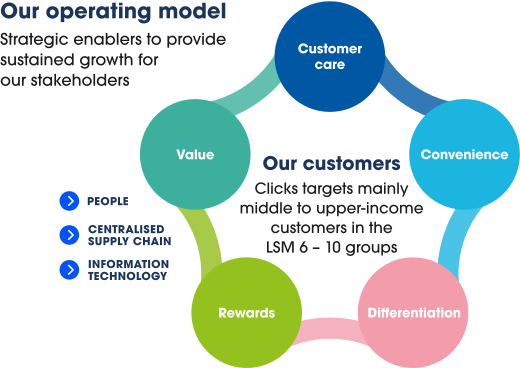
Customer care
Customer care from engaging and knowledgeable staff in the front shop and pharmacy.
Convenience
An extensive store footprint and pharmacy network in convenient locations allows for easy access to customers, supported by an online store and national pharmacy delivery service.
Differentiation
The product offering is differentiated through a wide range of private label and exclusive brands. Private label scheduled medicine ranges offer customers choice for quality generic medicine at a lower price.
Rewards
ClubCard enables Clicks to personalise engagement and communication with customers, supporting the aim of the loyalty programme to increase basket size, value and frequency of shopping.
Value
Consistently good value-for-money products delivered through competitive prices and effective promotions.
capital
- Diluted HEPS up 4.4%
- Dividend of 925 cents per share
- Return on equity 48.7%
- Cash generated by operations R6.3 billion
- R3.4 billion returned to shareholders in dividends and share buybacks
- Reinvested R1 166 million in capital expenditure
capital
- Opened net 41 Clicks stores
- Opened net 60 pharmacies
- 54.2% of households live within 5.0 km of a Clicks store
capital
- Retail pharmacy market share 24.7%
- Private pharmaceutical wholesale market share 25.4%
- Constituent of FTSE/JSE Top 40 Index
- Clicks private label sales account for 25.8% of total sales
capital
- Total carbon emissions 158 459 tonnes CO2e
- Electricity consumption non-renewable energy: Purchased electricity consumption 108 832 304 kWh
- Produced 5 469 MWh renewable energy
- Total municipal water consumed 67 998 kl
- Waste recovered for recycling 4 882 tonnes
- Electric delivery vehicles introduced for retail and pharmaceutical distribution
capital
- R976 million in cashback paid to ClubCard members
- R1 116 million paid in taxes in all countries of operation
- R44.8 billion paid to suppliers of goods and services, including landlords
- R143 million invested in enterprise and supplier development programmes
- R66 million paid to 18 small enterprise owner drivers contracted to UPD
- R34 million invested in socio-economic development programmes
- 78 bursaries awarded
- 2.9 million social media followers
- Level 3 BBBEE rating
capital
- R5.4 billion paid to employees
- 6 550 employees trained
- R275 million invested in employee training and development

R50.4bn
Group turnover
R38.7bn
Cost of merchandise sold
R4.9bn
Trading profit
158 459
Carbon emissions (tonnes CO2e)
Material trade-offs of capitals
In delivering on the group’s strategic objectives, management aims to balance and optimise the trade-offs between capitals to ensure long-term growth and sustainability.
While the commitment to investing in manufactured, intellectual, human, and social and relationship capital erodes financial capital in the short term. The long-term investment benefits are reflected in the group’s industry-leading financial and operating metrics and sustained shareholder value creation.
Limiting the environmental impact of the operations to reduce the rate at which natural capital is depleted has a significant impact on financial capital in the short to medium term but should deliver the desired long-term benefits as the group ultimately moves towards carbon neutrality.
Constraints on capitals

Financial capital: The group has no financial capital constraints owing to the strong cash flows generated by the operations and access to borrowings. Should additional resources be required, the group’s strong balance sheet will enable management to secure further loan funding or raise capital through the issue of shares.

Manufactured capital: The availability of retail trading space in the desired locations can limit the pace of new store openings, particularly in Clicks and UniCare.

Intellectual capital: The group continues to prioritise investment in training, technology, innovation and data protection while also protecting its intellectual property, so there are currently no immediate constraints on intellectual capital.

Natural capital: Water and electricity supply is constrained due to failing infrastructure.

Social and relationship capital: The weak economic environment and high energy, food and borrowing costs constrained consumer disposable income which negatively affected discretionary retail spending.

Human capital: Scarcity of skills is a constraint, especially in key areas where niche skills such as IT, healthcare and retail are in demand locally and internationally.