Corporate governance report
Accountability, transparency, ethical management and fairness underpin the Clicks Group’s governance and compliance frameworks.
The board and executive management are accountable for the group’s governance which is critical to executing its strategic objectives, ensuring sustainability and meeting stakeholder expectations. A consistent focus on corporate governance has supported the group’s sustained strong performance which is reflected in the long-term equity outperformance.
The group’s corporate governance standards are independently rated as aligning with global best practice.
Refer to the King V disclosure framework PDF
In the past year, notable governance matters considered by the group included:
- reviewing the structure of the board and its committees to ensure that the governing body is structured to serve the needs of the group and efficiently discharge its responsibilities. This resulted in the reconstitution of the nomination committee, which is responsible for ensuring that the board has the appropriate skills, experience and diversity to govern effectively;
- under the guidance of the nomination committee, strengthened the focus on the chief executive officer (CEO) and executive leadership succession planning and organisational design;
- appointing Bertie van Sittert as an independent non-executive director to broaden the experience of the board and ensure that stakeholders continue to benefit from a diverse, multi-skilled and balanced board;
- reviewing and updating the board charter and committee terms of reference to align with King V principles and recommended practices; and
- undertaking an externally facilitated evaluation of the board, committees and the company secretary, and considering the recommendations from the evaluation for enhancing the board’s governance maturity.
Transition to King V
King V applies to companies with financial years beginning on or after 1 January 2026. During the reporting period the group continued to apply the principles of King IV and following the publication of King V in October 2025, commenced the transition to the new code. The directors confirm that the group has in all material respects voluntarily applied the principles and recommended practices of the code, except for the specific exceptions noted in the Disclosure Framework. The King V Disclosure Framework is published on the group’s website at www.clicksgroup.co.za. The board intends to complete the transition in the 2027 financial year. The board is not aware of any material non-compliance by the company with the Companies Act, No. 71 of 2008 (as amended) (Companies Act), the JSE Listings Requirements or the memorandum of incorporation (MOI). The group also follows the JSE’s June 2022 guidance on sustainability and climate change disclosures in its annual reporting.
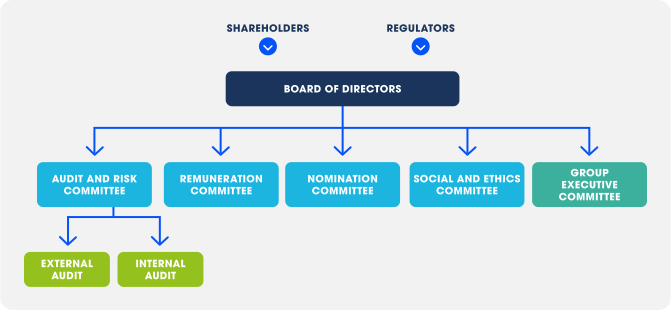
Governance structure
Role of the board
Elected by the shareholders, the directors are responsible for the sustainability of the business within the triple context of the economy, society and the environment.
The board fulfils a range of legal duties and is the primary source of effective, ethical leadership for the group. In executing its mandate, the board is responsible for the following:
- approving strategic plans;
- monitoring operational performance;
- ensuring that risk management and internal controls are effective;
- monitoring regulatory compliance;
- promoting good governance;
- approving significant accounting policies and the annual financial statements;
- monitoring transformation and empowerment;
- managing the process of selection and appointment of directors;
- ensuring that the group’s remuneration policies and practices are effective and fair; and
- appointment of key executive management.
Certain of these functions are delegated to board committees. The board and its committees’ composition, authority, responsibilities and functioning are detailed in the MOI, the board charter and the committees’ terms of reference.
Key issues addressed in 2026
In addition to the matters set out above, the board addressed the following key issues during the year:
- approved the group’s three-year strategic plans and budgets, including capital investment in information technology (IT) systems and physical infrastructure;
- monitored the execution of projects and initiatives approved in preceding years, including specific focus on the warehouse management system and enterprise resource planning system replacement at UPD; and revising the group’s organisational design to better equip it for sustained growth into the future which included the appointment of the chief information officer;
- considered the outcome of the independent assessment performed on the effectiveness of the board;
- entrenched ESG practices in the group’s ways of working, including reviewing the group’s environmental and climate change policy;
- considered the application of the amendments to the Companies Act;
- reviewed the group’s broader board diversity policy;
- considered and satisfied itself as to the competence, qualifications and experience of both the chief financial officer and company secretary;
- considered succession plans for the CEO;
- considered and adopted the group’s artificial intelligence (AI) policy;
- reviewed the group’s remuneration policy, with specific focus on long-term incentives for senior executives and non-executive director remuneration, and monitored progress in the attainment of the minimum shareholding requirement for executives. The group’s remuneration report is available on the website at www.clicksgroup.co.za; and
- reviewed talent and succession plans.
Board composition
The board consists of nine directors, with two salaried executive directors and seven independent non-executive directors. The age, tenure, experience and expertise of each director is briefly set out on this page.

Independence of directors
All the directors understand their legal duty to act independently in the best interests of the company.
The board conducted an evaluation of the independence of the chairman and non-executive directors during the year. The factors contained in King V and the JSE Listings Requirements which could impact on their independence and performance were considered. Both long tenure and length of concurrent tenure between non-executive directors and executive directors are metrics that are considered when assessing independence, which the board monitors and the group discloses to stakeholders. In the opinion of the board there are no factors which prevent the directors from exercising objective, unfettered judgement or acting in an independent manner. All of the non-executive directors are therefore appropriately classified as being independent.
The company has no controlling shareholder or group of shareholders and there is no shareholder representation on the board.
Board diversity
The directors are diverse in terms of gender, race and professional backgrounds, contributing to strong decision-making and ensuring that a range of perspectives are brought to bear on matters under consideration by the board. The directors have extensive experience and specialist skills across a range of sectors, including retail, commercial, governance, human resources remuneration, accounting and finance, legal, healthcare and IT. The board’s broader diversity policy contains voluntary targets for race and gender of 50% black and 33% female representation at board level. Currently 67% of the directors are black and 44% are female.
Director election
One-third of non-executive directors are required to resign at each annual general meeting (AGM) and executive directors are required to resign on the third anniversary of their appointment or most recent re-election to the board. This provides shareholders with an opportunity to hold directors to account and to appoint directors to the board who shareholders believe will add value to the business. Richard Inskip, Christine Ramon and Bertina Engelbrecht will retire in terms of the rotation of directors provisions in the MOI, and are all recommended for re-election to the board. Bertie van Sittert, who was appointed as a non-executive director by the board after the 2026 AGM, will also retire voluntarily at the 2027 AGM and will be recommended by the board for election by shareholders. Richard Inskip, Christine Ramon, Bertie van Sittert and Nomgando Matyumza will be recommended for election to the audit and risk committee. Nomgando Matyumza, Dr Penny Moumakwa and Bertina Engelbrecht will be recommended for election to the social and ethics committee.
Annual performance evaluation
An independent external evaluation of the board, its committees and the company secretary was conducted in 2026. The review was undertaken through in-depth director interviews, online survey, governance document review and analysis of board dynamics. Based on the review the board was assessed as a strong effective board that is engaged and well regarded. The board exercises sound oversight and holds management to account effectively while protecting shareholder value. The evaluation identified opportunities for further strengthening long-term strategic alignment, anticipating risk and partnering with management to drive sustained growth and superior shareholder returns, areas which the board will be looking to incorporate into its governance practices.
Board and executive relationship
The roles of the chairman and the CEO are formalised, separate and clearly defined. This division of responsibilities at the helm of the company ensures a balance of authority and power, with no individual having unrestricted decision-making powers. The chairman leads the board and the CEO is responsible for the executive management of the group. The CEO’s notice period is 12 months and there are no special conditions related to termination. While the board and executive management collectively determine the strategic objectives of the group, the board is responsible for approving the group’s strategy, and the executive is responsible for executing this strategy and for the ongoing management of the business. Regular reporting by the executive on progress made in executing its mandate allows the board to monitor implementation of strategy and to assess the effectiveness thereof. Non-executive directors have direct access to management and may meet with management independently of the executive directors.
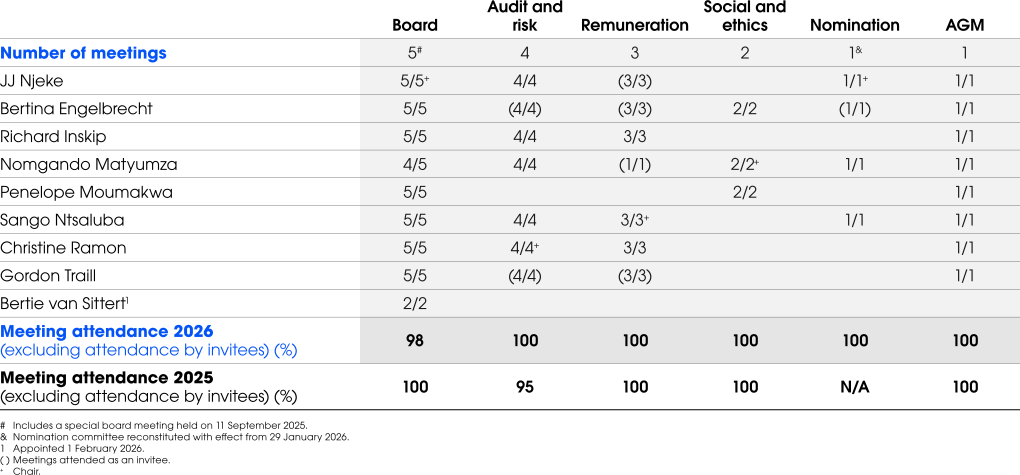
Board and committee meeting attendance
Board oversight
The board discharges its oversight function both directly and through its four committees. This allows the board to allocate sufficient time and attention to matters reserved for decision-making. The board and its committees are each chaired by independent non-executive directors. Each board sub-committee has a clear mandate and terms of reference that are regularly reviewed. The composition of the committees conformed to regulatory requirements and King IV and V for the reporting period.
Risk governance
While the board recognises that certain risks are necessary to ensure sustainable growth and competitive returns, the directors acknowledge that the group and its stakeholders should be protected from avoidable risks. Risk management and governance processes are therefore aimed at creating an appropriate balance between risk and reward. The risk landscape is managed through ongoing improvement of internal controls, including risk identification, assessment, mitigation and monitoring. This is achieved through collaborative efforts between the various business units and internal audit.
The audit and risk committee is responsible for overseeing risk management for the board, with particular focus on combined assurance arrangements, ensuring that the group has implemented an effective policy and mitigation plan for risk, and that disclosure of these risks and mitigation plans is comprehensive, timely and relevant. The committee is tasked with ensuring that the combined assurance model provides a co-ordinated approach to assurance activities and that the combined assurance received addresses all significant risks facing the group. The group and business unit risk registers are regularly reviewed and updated, containing current and emerging risks as well as risks associated with future strategic initiatives and identifying mitigating measures to address specific risks. Risk registers are updated as the nature of the risk changes over time or as mitigation measures take effect.
Group internal audit monitors the progress of the group and business units in managing risks and reports its findings to the audit and risk committee. Any significant weaknesses in the design, implementation or execution of the group’s internal financial controls which could result in material financial loss, fraud, corruption or error, are reported to the audit and risk committee and disclosed in the audit and risk committee report. No material issues were brought to the attention of the committee during the reporting period.
Data, information and technology governance
IT is a fundamental enabler within the group and essential to the effectiveness and sustainability of the group’s growth ambitions. The group relies on technology to drive growth, improve efficiency and enhance customer experience. The group’s IT strategy is developed to guide IT investments, strategic project enhancements and the maturity of IT processes. The board is ultimately responsible for the governance of data, information and technology. The accountability is formally delegated to the audit and risk committee. The group has adopted an AI policy and is in the early stage of the implementation of innovative and disruptive technologies, including AI. As the group’s adoption matures and the evolving risk landscape increases, the board recognises that significant risk management and governance oversight will be required. This will receive significant focus in 2027.
Ethics and values
The group subscribes to high ethical standards of business practice. A set of values and a behavioural code of conduct require staff to display integrity, mutual respect and openness. Members of staff have an obligation to challenge others who are not adhering to these values. The social and ethics committee is responsible for monitoring ethical practices. The group has various documented policies which require all employees to adhere to ethical business practices in their relationships with one another, suppliers, intermediaries, shareholders and investors. These policies also set stringent standards relating to the acceptance of gifts from third parties and declarations of potential conflicts of interests. A fraud prevention policy ensures that a firm stance is taken against fraud and the prosecution of offenders.

Anti-competitive conduct
Oversight, governance and risk management processes are in place to promote compliance with statutory prescripts relating to competition, and the effectiveness of these processes is borne out by the fact that the group has not been sanctioned for anti-competitive conduct.
The group has market-leading positions in South Africa in healthcare retailing and supply. This emphasises the need for the group to remain vigilant in guarding against engaging in anti-competitive practices.