
Governance and oversight of material issues
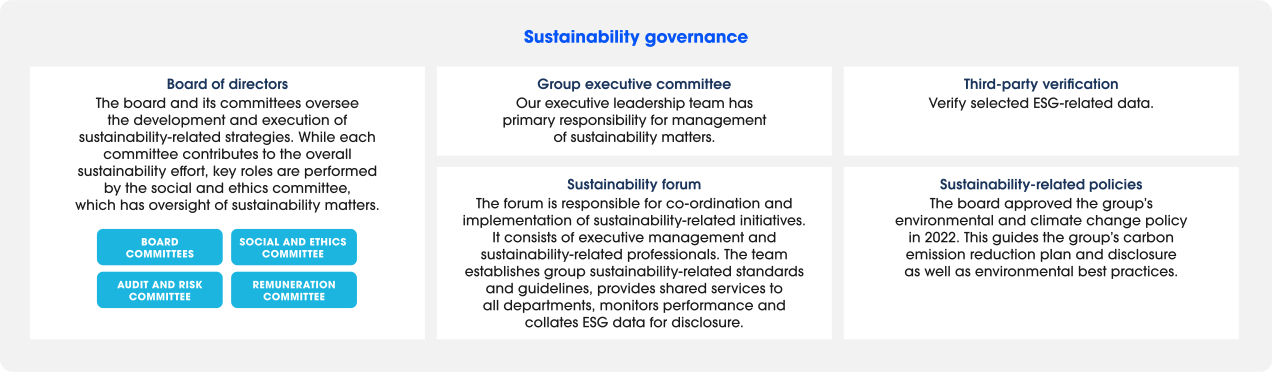
The board retains overall accountability for oversight of the group’s material sustainability issues. The social and ethics committee monitors the response to sustainability-related risks, opportunities and impacts. The audit and risk committee oversees climate risk and related internal controls, while the remuneration committee considers internal equity, responsible reward frameworks and the alignment of incentives with strategic delivery.
The group executive committee is accountable for implementation and performance, supported by a cross-functional sustainability steering committee that sets standards, provides shared services, monitors progress and consolidates ESG data for disclosure. ESG-related KPIs are integrated into executive scorecards and business unit objectives. The board committees receive quarterly reports. Each operational head is responsible for their department’s ESG performance and provides periodic updates to the sustainability team for group consolidation.
Selected ESG metrics are verified by independent third parties. Sustainability-related policies, including the environmental and climate change policy, are integrated into the business and used to guide operations.
Management approach
The group implements its sustainability approach through board-approved policies, delegated oversight structures, executive scorecards and business unit objectives. The sustainability steering committee co-ordinates implementation, monitors progress and consolidates ESG data for reporting. The approach draws on the UN SDGs, JSE Sustainability and Climate Change Disclosure Guidance, IFRS S1 and IFRS S2, GRI, the UN Global Compact and CDP. Operating controls include quarterly board committee reporting, ESG risk and opportunity reviews, data-owner accountability, sustainability KPI tracking, policy-based procedures, supplier due diligence, climate and emissions management processes, and independent assurance over selected ESG metrics.
Key board discussions
This year, the board considered climate-related risks and opportunities affecting the group, alongside electricity supply risks in certain regions of South Africa. Discussions on intermittent electricity supply centred on its potential operational, financial and service delivery implications, as well as the measures required to strengthen business continuity and operational resilience.
The severe flooding experienced in the north-eastern parts of South Africa in early 2026 highlighted the group’s exposure to extreme weather events and potential disruption to its operations and value chain. These events prompted board discussions on climate resilience, including the adequacy of existing mitigation measures and opportunities to strengthen supply chain resilience, reduce disruption and improve preparedness for future climate-related incidents.
In support of the group’s decarbonisation strategy and commitment to reducing greenhouse gas (GHG) emissions, the board approved the deployment of additional EVs within UPD’s fleet during the year. The board also reviewed plans to expand the use of EVs at the Clicks distribution centre. The status of vehicles deployed and those remaining in the pipeline is described in the environmental performance review. These initiatives form part of the group’s broader efforts to transition to lower-carbon operations, improve energy efficiency and support
its long-term sustainability objectives.

Remuneration-linked ESG
The group links remuneration outcomes to the delivery of strategic and sustainability priorities by incorporating ESG measures into executive incentive scorecards. Both short-term and long-term incentive arrangements include sustainability-related performance metrics, supporting accountability for progress against the group’s ESG commitments and reinforcing responsible long-term value creation.
Where ESG performance thresholds are not achieved, incentive outcomes may be adjusted downwards by up to 15%, ensuring that reward outcomes remain aligned with the quality and sustainability of business performance. Further detail is provided in the remuneration report. In addition, following the data breach incident at UPD during the year, incentive outcomes will be reduced accordingly to reflect the impact of the event and reinforce management accountability for risk management, operational resilience and sustainable business performance. Further detail is provided in the remuneration report.
Our approach to determining sustainability material topics
Since 2024 the group has applied a double materiality approach, considering both its impacts on people and the environment and sustainability-related risks and opportunities that may affect long-term value creation. Stakeholder engagement informs the identification and prioritisation of material topics, which are integrated into strategy, risk management and reporting. This broader assessment also informs the group’s work on IFRS S1 and IFRS S2; it does not, by itself, establish compliance with those standards. During the year the group refreshed its materiality review to reflect its operating context and emerging governance expectations, including King V principles. A comprehensive reassessment is planned for 2027 and every two years thereafter, to maintain relevance to stakeholder expectations and business priorities.
Key findings
The assessment identified sustainability-related risks and opportunities that could influence Clicks Group’s
long-term value creation and strategy. Key opportunities include improving access to affordable healthcare through medicines, primary healthcare services and digital health solutions. Other material topics include climate change, workforce well-being, fair remuneration, diversity and inclusion, data privacy and cybersecurity, waste management, water stewardship, biodiversity, sustainable sourcing, regulatory requirements, health and safety, and supply chain resilience. As the group expands its digital and omni-channel healthcare offerings, data privacy and cybersecurity remain critical priorities. The UPD data breach reported during the year underscores the importance of these risks and the need for transparent reporting on the response and remediation.
Emerging risks and opportunities
The emerging sustainability-related risks and opportunities assessment highlights an operating environment influenced by climate change, resource constraints, evolving regulation, healthcare affordability pressures, rising ESG disclosure expectations and accelerating adoption of digital technologies and artificial intelligence. These trends create challenges for supply chain resilience, compliance, data governance and service delivery. They also create opportunities to expand affordable healthcare access, improve responsible sourcing and strengthen sustainability reporting. The group’s response to these developments is intended to support operational resilience, sustainable growth and long-term value creation as a trusted healthcare partner.